Jefferson’s Revolutionary Language
Of the delegates who assembled in Philadelphia in 1776 for the Second Continental Congress, only Thomas Jefferson possessed the skill, knowledge, and linguistic gifts to make the Declaration of Independence an immortal text. He was the self-appointed conscience of America, and sensational imagery was his stock-in-trade.
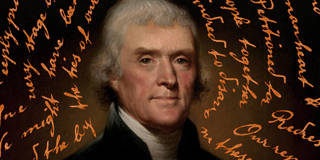
CHARLOTTESVILLE – While most American revolutionaries railed against members of the British Parliament, select ministers, or crown-appointed colonial governors, Thomas Jefferson aimed his demands straight at the top. In 1774, the gutsy young activist from rural Virginia commanded King George III: “Open your breast, sire, to liberal and expanded thought. Let not the name of George the third be a blot in the page of history.”
The tract containing this exhortation, A Summary View of the Rights of British America, found its way not just to Philadelphia and Boston, but also to London. But its impact would be dwarfed by that of the Declaration of Independence, to which Jefferson would bring his fiery pen two years later.
An Isolated Visionary
“I have sworn upon the altar of God,” Jefferson wrote in 1800, “eternal hostility against every form of tyranny over the mind of man.” That hostility was a defining feature of Jefferson’s legacy, with his assertion being immortalized on the Jefferson Memorial in Washington, DC. At a time when the educated classes were increasingly questioning institutional power, perhaps no one was as incensed about the monarchy’s persistence as Jefferson.
But anger alone did not define Jefferson’s contributions to the American revolutionary spirit. Of the authorized representatives of the “United Colonies” who nervously assembled in Philadelphia in the late spring of 1776 for the Second Continental Congress, only Jefferson possessed the linguistic gifts, in addition to the legal and philosophical background, that would make the Declaration an enduring text.
Jefferson was never “just” a politician. He was a bibliophile, having collected some 1,500 books spanning history, ancient and modern, politics, novels, and epic poetry by the time the Declaration was written. He held that a gentleman’s library should be eclectic and invigorating – he could read six languages – not merely decorative.
Jefferson was also a self-taught architect, who built his home atop an 867-foot-tall mountain. In that private dreamworld, he could escape from public life, relish his life of the mind, and marvel at his idyll. “I am but a son of nature,” he wrote in 1788, “loving what I see and feel, without being able to give a reason, nor caring much whether there be one.”
But as much as he cherished his solitude, Jefferson also longed to commune with likeminded thinkers. This at least partly explains the deftness, emotional resonance, and even seductiveness of his written communication. This skill, together with the passion of his convictions, would take Jefferson far in politics. It would also help to define America’s trajectory – and that of the world.
The Penman’s Passion
The Preamble of the Declaration is the most widely remembered section, but it is not where Jefferson’s most emotive language is found. His description of man’s “unalienable Rights” to “Life, Liberty,” and the vaunted “pursuit of Happiness” are cribbed from John Locke. As Jefferson later acknowledged, the preamble’s main purpose was to find common cause among delegates from colonies with diverse interests. No one would object to the idea that a just government was predicated on “the consent of the governed.” The one phrase that bore a Jeffersonian tone – “we hold these truths to be sacred and undeniable” – was changed to the stale “to be self-evident.”
It was in the text that followed that Jefferson truly put his stamp on the Declaration. In his list of the “injuries and usurpations” suffered by Americans, Jefferson used cascading verbs to raise the volume of protest: the king has “forbidden,” “dissolved,” and “obstructed.” These culminate in the ultimate accusation: “He has plundered our seas, ravaged our Coasts, burnt our towns, and destroyed the lives of our people.” Jefferson’s words left no doubt: this was an abusive monarch, who had dispatched armies to lay waste to the land and wreak havoc on a peaceful population.
Even more powerful, however, was Jefferson’s impassioned refrain evoking voracious predators. The king “sent hither swarms of Officers to harass our people and eat out their substance,” he wrote, conjuring images of something akin to a cross between killer bees and flesh-eating bacteria.
Though Jefferson’s fellow delegates generally preferred more legalistic language, they did not temper this formulation. Nor did they remove his lament that, “In every stage of these Oppressions We have Petitioned for Redress in the most humble terms,” but “Our repeated Petitions have been answered only by repeated injury.” The delegates of the Second Continental Congress even backed the blistering charge that the king’s “character” was “marked by every act which may define a Tyrant,” rendering him “unfit to be the ruler of a free people.”
But Congress did delete the audacious indictment that followed in Jefferson’s original draft: “Future ages will scarce believe that the hardiness of one man, adventured within the short compass of 12 years only, on so many acts of tyranny without a mask, over a people fostered & fixed in principles of liberty.”
Jefferson did not target only the king with his pen. He also condemned the British more broadly, noting that the colonists had “appealed to their native justice and magnanimity,” and “conjured them by the ties of our common kindred to disavow these usurpations,” yet they had “been deaf to the voice of justice and of consanguinity.”
With their “British brethren” having abandoned them, Jefferson concluded, the colonists had little choice but to hold those to whom they were once bound by blood, as kin, as they held the “rest of mankind”: as “Enemies in War” and “in Peace, Friends.” This line personalized the pain and heartache while leaving open the hope for a resumption of friendly ties after American independence was secured and equality was established between Britain and its former colonies.
But again, while the delegates approved Jefferson’s general tone and cadence, they tactfully removed the more visceral imagery of his original draft, which condemned the British for being apparently unmoved by the fact that mercenary troops were sent to “deluge” the colonists “in blood.” This, he wrote, was “the last stab to agonizing affection.” Jefferson concluded his composition with a simple but affecting lament: “We might have been a free & great people together.”
Galvanizing a Revolution
Jefferson did not use poetic language for its own sake. As a reader of classic literature, he understood the power of such language to affect those reading it, especially at a time when sentimental, heart-rending novels, bordering on the maudlin, were popular. The fact that the other delegates gave Jefferson as much leeway as they did reflects their recognition of the need to kindle resistance among the many. After all, a considerable minority of Americans were still loath to abandon crown authority.
To change their minds, Jefferson unmasked the king’s cruelty, while masterfully tapping into the vocabulary of “fellow-feeling” that was associated at that time with the Scottish philosophes, of which Adam Smith’s The Theory of Moral Sentiments is perhaps the best example. Jefferson had studied divorce law for a case he had taken on a few years earlier, at the height of his legal career. His careful notes on a chapter on “Willful Desertion” in the renowned German jurist Samuel von Pufendorf’s On the Law of Nature and Nations focused significantly on fairness and moral conscience, again consistent with the work of Smith and his Scottish colleagues.
The Declaration delivered the unmistakable impression of Britain as a brutal husband who had rejected the fond feelings that had sustained his marriage, removing the other side of that union from “his protection.” This left the colonies with one option: to band together and renounce their allegiance to the crown, separating their destinies from this cruel patriarch before he succeeded in tearing them limb from limb. Casting America in human terms, as the victim of an unfeeling tyrant, was perhaps Jefferson’s most dramatic rhetorical choice, and its impact was undeniable.
Beyond the words he chose, Jefferson had an exceptional ability to use rhythm and cadence to strengthen his message. A musician who lovingly played the violin at home, Jefferson made use of rhythmic inflections to create an almost melodic composition. He was attuned to the “blue” notes when he wrote to friends to commiserate with their suffering and in the Declaration, particularly in the section focused on the colonists’ consanguineous ties to their British brethren. Four years after the death of his wife, he wrote of his private suffering to Maria Cosway: “Deeply practiced in the school of affliction, the human heart knows no joy which I have not lost, no sorrow of which I have not drank! Fortune can present no grief of unknown form to me!”
Jefferson was the self-appointed conscience of the young republic, and sensational imagery was his stock-in-trade. When he became the United States’ third president in 1801, he articulated a vision of the republic that embraced the popular while guarding minority rights. “Let us restore to social intercourse,” he proclaimed, “that harmony and affection without which liberty and even life itself are but dreary things.” Once more, as in his poignant Declaration, he sought the world’s attention by speaking to and for the human heart.
Andrew Burstein, Professor of History Emeritus at Louisiana State University, is the author, most recently, of Being Thomas Jefferson: An Intimate History (Bloomsbury, 2026).
