No Exit from Stalin
While Russia has not reverted to full-bore Stalinism, there is no doubt that President Vladimir Putin has made tremendous strides toward totalitarianism. That is why people have sought lessons in history—in particular, in the story of how calls for change emerged at the commanding heights of the USSR.
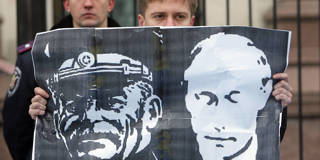
OSCOW—An account of how Stalinism was dismantled in the Soviet Union, published more than seven decades after the tyrant’s death, should be one of those books you pick up to discover, or rediscover, the past. But 26 years into Russian President Vladimir Putin’s rule, the University of Cambridge historian Mark B. Smith’s Exit Stalin: The Soviet Union as a Civilization, 1953–1991 reads more like a manual—a means of decoding Russia’s recent past and perhaps even getting a glimpse of its future trajectory.
Smith’s history is not the first to meet this fate. When I began writing a new biography of my great-grandfather, Nikita Khrushchev—the Soviet premier who initiated de-Stalinization in 1956—in 2000, it was already more than a history book, because criticism of Khrushchev’s actions (which many called a betrayal) were running rampant in Russia. By the time the book was published in Russia in 2024, its relevance was inescapable.
This was, after all, nearly two decades after Putin began his slow rehabilitation of Stalin’s image, telegraphing his plans to unravel whatever messy progress Russia had made toward democratization. And it was just two years after Russia’s full-scale invasion of Ukraine, which ushered in not only a protracted war against Ukraine’s people and infrastructure, but also a sharp crackdown on dissent within Russia.
Russians today can face punishment for all manner of mundane, seemingly nonpolitical acts. An unruly garden, for example, can get one’s land confiscated. Cleaning carpets in a courtyard, transferring plants in one’s car, or allowing noise or odor to emanate from one’s flat can lead to hefty fines.
There is little distance between such arbitrary rules and Kremlin paranoia. The head of the Kremlin’s unironically named Council for the Development of Civil Society and Human Rights has warned against the use of smart speakers, which can be used to spy on their owners. He also recommended, with total sincerity, using brooms or mops for household cleaning, because vacuum cleaners apparently can also facilitate surveillance.
This paranoia is codified in the Kremlin’s ever-expanding list of prohibitions, which includes internet phone calls (like those made using WhatsApp and similar messaging services), a growing number of websites, public gatherings that might even remotely resemble protests, and the use of foreign words (such as on business signage).
Tightening restrictions on abortion are particularly reminiscent of Stalin, who outlawed it. But perhaps Stalinism’s loudest echo is contained in the “foreign agent” label, which has become almost the equivalent of the Soviet-era designation “enemy of the people”—a term Khrushchev banned as part of his de-Stalinization effort.
When the foreign-agent law was enacted in 2012, it was applied to individuals or organizations that receive international funding. Now, it is being used increasingly broadly, with thousands of people, including longtime Kremlin loyalists, banned from holding public office or performing publicly financed work (such as writing or teaching), thus depriving them of income inside and outside Russia.
This is not Stalinism yet. While thousands of dissenters have faced punishment for their “crimes” under Putin, millions rotted in Stalin’s Gulags. But there is no doubt that Putin has made tremendous strides toward restoring totalitarian control of society. That is why many people are seeking lessons in history—in particular, in the story of how calls for change emerged within Stalin’s circle, at the commanding heights of the USSR.
The Path of Reform
How could Khrushchev, once a loyal comrade of Stalin, turn against him, denounce his cult of personality, and try to put the Soviet Union onto a different path? According to Khrushchev, this process began well before the public knew anything about it. In fact, he insisted, he was coerced into backing Stalin during those brutal years, which included the Great Purge. Fearing for his life, he could voice his reservations only after Stalin’s death.
Could the same be true of Putin’s associates? Might there be a leader among them who, after Putin’s death, might push for de-Putinization? What about Dmitry Medvedev, who served as Russia’s somewhat liberal president from 2008–12, while Putin, not yet prepared to overturn constitutionally mandated term limits, bided his time as prime minister? One can imagine Medvedev, who now holds a vanity title while writing a militantly pro-Kremlin blog, claiming that he had no choice but to back Putin’s march toward totalitarianism.
But even if fear does explain Medvedev’s shift from liberal sentiments like “freedom is better than unfreedom” to vulgar insults of Russia’s “enemies” (“grunting piglets,” “cockroaches breeding in a jar”), it is far from clear that he would take real responsibility for his role in the Kremlin’s crimes. For Khrushchev, such an admission—“I have my hands covered in blood up to the elbows”—was essential.
Smith tells this story much more eloquently than I did. He puts Khrushchev and the “thaw” he initiated “at the heart” of the post-Stalin “process of evolution and transformation” of Soviet civilization. Khrushchev “always had good eyes,” Smith writes; “however high he rose, he could see things from the perspective of ordinary people.” But, like other Kremlin leaders, he was a “bad listener,” convinced that he knew best.
So, while Khrushchev “pursued the popular yearning for conscience, justice, and sincerity,” he “was prepared quite often to ignore it.” This is reflected in his inconsistent policies. For example, just months after announcing de-Stalinization, he sent Soviet tanks into Budapest to crush the 1956 Hungarian Uprising. Despite his flaws, however, Khrushchev sought to narrow the gap between rulers and ruled, such as by opening the Kremlin to the public and reopening the nearby GUM department store, which Stalin had shuttered in 1930.
This brings us to one of Exit Stalin’s central (though not particularly groundbreaking) observations. Because Russian civilization is defined by boundaries—between past and future, between East and West, and so on—the USSR’s various eras, from Khrushchev’s thaw to Mikhail Gorbachev’s perestroika, are perhaps best understood in terms of the strength of each of these boundaries. By easing the most important boundary—that between the public and the state—Khrushchev opened the way for systemic renewal.
A Conflicted Civilization
A weakness in Smith’s analysis is his assertion that the 1917 Bolshevik Revolution contained within it many possible futures, and various “unresolved paradoxes”—the “endless revolution,” the “decolonized empire”—ultimately “sustained,” rather than undermined, “Soviet civilization.” While Smith views this as a “substantially new framework” for understanding the Bolshevik state, I am not convinced.
As the double-headed eagle in its coat of arms suggests, Russia has always been a country of stark contradictions. With a geography that spans 11 time zones, how could it not be? Its culture and society have post-Enlightenment Europe as a model, but more often than not its political system has been despotic and opaque. But whereas such contradictions would cause any rational nation to collapse, in Russia, each iteration of crisis merely mutates into a new cycle of existence. Russian history, from the czars to the Soviets, oscillates between repression and reform.
Nowhere is this clearer than in the post-Stalin succession sequence: Khrushchev pursued de-Stalinization, only for Leonid Brezhnev to restore a more restrictive approach, at least outwardly (Brezhnev oversaw half as many political prosecutions as Khrushchev). As Smith perceptively observed, “In the early Brezhnev era, uniforms displayed top-down coercive power while also hinting at the limits of that power.”
Where Smith’s analysis shines is in his ability to move his narrative from politics to culture to history to personal stories, thereby capturing the rich texture of a society in transition. Rarely has a non-Russian writer demonstrated such a profound understanding of the cultural details and idiosyncrasies that have influenced the formation of Russian society after Stalin. (Smith’s late wife, the Soviet-born Larisa Shikova, may deserve some credit here.) In the process, Smith offers something of an indictment of the current regime, without discussing Putin directly.
Some of the heroes to which Smith introduces his readers have direct links to Putin’s Russia. Lyudmila Ulitskaya—who first appears in the book as a 17-year-old would-be biology student attempting to get to the funeral of the famed poet Boris Pasternak—became “one of the greatest novelists of post-Soviet Russia.” Today, Russian libraries and bookstores do not stock Ulitskaya’s books, and Ulitskaya is living in exile in Berlin. She fears returning to Russia, as she was branded a foreign agent for speaking out against the Ukraine war.
The Soviets banned books, too—even after Stalin. Khrushchev proscribed Pasternak’s novel Doctor Zhivago, which depicted the struggles of aristocrats before and after the Bolshevik Revolution, and Kremlin apparatchiks subsequently forced Pasternak to decline the Nobel Prize in Literature. But Khrushchev later ordered an end to the campaign against Pasternak, whom he described as a confused intellectual, rather than a deliberate enemy of the people.
Khrushchev later expressed deep regret that “this novel was not published in its time,” noting that he had not even read it; he had allowed “administrative measures” to influence the decision. But “police methods” should never be used to “condemn creative people,” who “depict in their works the relationships between people, their spiritual experiences, their contacts with the authorities.” Recognizing that one might consider his condemnation of censorship to have come “too late,” he also wrote: “Yes, it’s late, but better late than never … Let the author’s recognition depend on the reader.”
Two Steps Back
Khrushchev’s reversal on Pasternak reflected an understanding of nuance that is nowhere to be found in today’s Kremlin, and his expression of regret showed a degree of humility that current leaders, from Putin to Medvedev, are unlikely even to attempt to match. In fact, a key lesson of Smith’s book is that, as misguided as the Bolshevik vision was, it was driven by a desire for progress—something that leaders like Khrushchev understood. The opposite is true of Putin’s fundamentally regressive vision for Russia.
A telling example is gender equality, which the Soviets championed. While a lot of it was propaganda, and men still enjoyed considerable advantages, women were welcomed into the workforce as writers, scientists, actors, engineers—you name it. Today, girls are encouraged to give birth as early as high school, partly to stave off Russia’s catastrophic demographic decline, which the Ukraine war has accelerated. It is as if women’s emancipation (a cause to which Russia contributed) never happened.
Another example is science. The Soviets placed a high priority on scientific research, and under Khrushchev, the USSR racked up several breakthroughs, from launching the first artificial Earth satellite, Sputnik, to sending the first human, Yuri Gagarin, into space. In 2020, Putin called for the development of “high-level technology,” in order to secure the future of Russia’s “distinct civilization.” Since then, however, Russia has experienced “reverse industrialization,” with economic activity shifting to more labor-intensive sectors, owing not least to the Ukraine war, which has contributed to Russian brain drain.
This past February, Khrushchev’s de-Stalinization campaign marked its 70th anniversary. The following month, the Kremlin labeled me a “foreign agent.” Enter Stalin.
- Mark B. Smith, Exit Stalin: The Soviet Union as a Civilization, 1953–1991, Allen Lane, 2026.
Nina L. Khrushcheva, Professor of International Affairs at The New School, is the co-author (with Jeffrey Tayler), most recently, of In Putin’s Footsteps: Searching for the Soul of an Empire Across Russia’s Eleven Time Zones (St. Martin’s Press, 2019).
