What Ukraine’s Success Means for the West
There are several reasons why Ukraine has been able to stymie its much larger aggressor. For the world’s democracies, the most important lesson to draw from Ukrainians' doggedness and brilliant innovations and improvisations may be that we should not be so surprised.
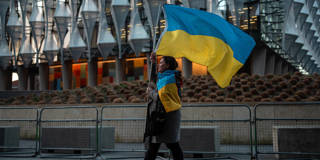
OXFORD—The changing face of the battle for Ukraine has taken much of the world by surprise, both in terms of the horrific scale of casualties that Russia is enduring—nearly 40,000 last month, according to Ukrainian officials—and the dynamism and sheer chutzpah that has characterized Ukraine’s war effort.
For the world’s democracies, the most important lesson to draw from Ukraine’s doggedness and brilliant innovations and improvisations may be that we should not be so surprised. Our lack of confidence in Ukraine, particularly at the start of the war, and our overestimation of Russia’s military might, is closely connected to our weakening faith in democracy as a system. This political alienation is not only wrong, but dangerous. The courage and determination of ordinary Ukrainians in the face of almost immeasurable challenges should give us more confidence in our core values and way of life.
Ukrainians recently demonstrated those values after four and a half years of war. When determined and constructive mass public protests erupted in the wake of Defense Minister Mykhailo Fedorov’s sacking last week, President Volodymyr Zelensky responded no less constructively to the complaints by replacing the army commander-in-chief who had opposed Fedorov and his focus on high-tech warfare, underscoring the remarkable fact that Ukraine is determined to fight this war as a democracy.
The Roots of Perseverance
There are several reasons why Ukraine has been able to stymie its much larger aggressor. For starters, Ukraine is not the fractured society Russian President Vladimir Putin brutishly proclaims it to be. Archbishop Borys Gudziak, head of the Ukrainian Catholic Church in the United States and president of the Ukrainian Catholic University in Lviv, told me, shortly after the war started, that Zelensky is so effective because he is following the lead of the ordinary people of Ukraine. That much was clear in his response to the countrywide pro-Fedorov demonstrations.
The fundamental importance of unity under fire should be familiar to the West. What we are seeing in Ukraine is a latter-day version of the united, democratic British national spirit we recall so proudly in commemorating the escape from Dunkirk, 86 years ago last month.
Ukraine’s system of decentralized, grassroots military procurement is an example of democratic unity in action. Brigades buy their own weapons, directly from arms-makers. Sometimes, they make their own weapons. That means very close interaction between fighters and weapons makers, with innovation cycles sometimes as truncated as two weeks. The defense ministry rewards the most successful brigades with more money to buy weapons. Civilians can and do make direct contributions to their favorite units.
Armin Papperger, CEO of Rheinmetall, the giant German defense firm, commented on this very homegrown defense sector at the end of March: “It’s Ukrainian housewives,” he told an interviewer. “They have 3-D printers in the kitchen, and they produce parts for drones. This is not innovation.”
Ukrainians could have been insulted, but they decided to see the comment as a back-handed compliment. A #MadeByHousewives hashtag went viral on Ukrainian social media within 24 hours. My friend Oleksandr Kamyshin replied on X: “Rheinmetall says our #LEGODrones are #MadeByHousewives in their kitchens. Fine. Meanwhile our #LEGODrones already burned more than 11,000 Russian tanks.” Unsurprisingly, Rheinmetall walked back the comment, posting: “We have the utmost respect for the Ukrainian people’s immense efforts in defending themselves … It is to Ukraine’s particular credit that it is fighting highly effectively even with limited resources.”
At the same time, Ukraine has found that its diversity is its strength, something many Western democracies also should remember. In a political environment where inclusiveness is derided as virtue-signaling, if not positively dangerous, and where we are subjected to US Secretary of Defense Pete Hegseth’s cartoonish cosplay of vitriolic white Christian masculinity in the Pentagon, Ukraine’s lived reality of war—neither macho nor ethnically rooted—is a powerful corrective.
Women are central to Ukraine’s war effort. Consider Iryna Terekh, the CEO of Fire Point, and possibly the very “housewife” who inspired Papperger’s thoughtless comment. She makes the “flamingo” missiles that were used in the strike on Titan-Barrikady, the Volgograd producer of launch systems for ballistic missiles, last month.
Terekh is in her early thirties, a mother of two, and trained as an architect. She decided to become a missile maker after surviving, with her children and a girlfriend, the occupation and massacre of civilians in Bucha at the start of the war. Terekh escaped unscathed, and told herself she never wanted to be afraid of being raped by invading soldiers again. At presentations, she likes to give out hot-pink socks, labeled “MILF tech,” inscribed with the motto, “Keep your legs warm and your arsenals full.”
Ukrainian women are fighting, too, including in combat positions. Some 20% of military cadets are women and an astounding 80% of Ukrainians support women’s inclusion in the military. Ukrainian women soldiers tell me they see fighting as feminine. Ukrainian mothers are especially convinced of this. After all, it is a mother’s job to protect her children.
Defining the Nation
Ukraine today is very intentionally a political nation. It is fighting this war as a society united by its values, rather than the sort of “blood and soil” ethnic bond that captivates right-wing populists. Muslim Crimean Tatars, for example, are an important and celebrated part of the war effort, particularly doing dangerous espionage and sabotage operations in Russian-controlled Crimea. And, of course, Ukraine’s war leader, Zelensky, is proudly Jewish.
Another important lesson Ukraine provides to the West is that patriotism can be a powerful force in defense of liberal democracy. Patriotism often frightens or alienates liberals and progressives, especially when they see it evoked by the extreme right. But patriotism is being harnessed to unite not only Ukraine, but democracies like Denmark, Canada, and Spain, all of which feel threatened by the United States under President Donald Trump.
To survive, small democracies need allies, and democratic Europe, unlike Trump, is stepping up for Ukraine. It is trendy, especially in US business circles, to write Europe off as rudderless and economically stagnant: “a pretty museum,” a trope embraced by the Trump administration and MAGA Republicans in Congress. But today, when it comes to Ukraine, Europe is meeting the moment.
With former Prime Minister Viktor Orbán’s ouster in Hungary, Europe has defended its own democracy, and is now united on Ukraine. European Union membership played a critical role in the Hungarian vote. Slovakia’s Prime Minister Robert Fico, who has flirted with pro-MAGA, anti-Ukrainian positions, has now publicly backed Ukraine’s EU membership bid. That has unblocked the EU’s €90 billion ($102 billion) loan—hugely significant support that will keep Ukraine solvent and able to fight through 2026 and into 2027.
Europe’s attitude toward Ukraine, and toward Russia, is entirely different from its position at the beginning of the full-scale Russian invasion. Polish Prime Minister Donald Tusk, speaking at an informal European Council meeting in late April, expressed what is increasingly the mainstream European view: “I want to wake up those who are living under illusions. Russia is preparing for further acts of aggression.”
As a result, for Europe, Ukraine is no longer a charity case, or a righteous victim to be pitied. Europe has come to view Russia as an existential threat, and Ukraine as the only country in the world that knows how to keep Russia at bay. Ukraine is now—quite rightly—seen as Europe’s shield and arsenal.
Renegade America
The contrast with the US under Trump is jarring. Not only has the US withdrawn most support for Ukraine, but it has also shown real sympathy to Russia—and is proud to say so. In April, Vice President JD Vance told Turning Point USA, the late Charlie Kirk’s quasi-evangelical, MAGA-friendly activist group: “One of the things I’m proudest that we’ve done in this administration is that we told Europe: if you want to buy weapons, you can, but the United States is not buying weapons and sending them to Ukraine anymore. We’re just out of that business.”
The same month, Hegseth, testifying to the Senate Armed Services Committee, was shown a chart by Senator Angus King of Maine illustrating that Ukraine has been receiving aid only from European states. “I think that is a beautiful chart,” Hegseth smugly replied. Meanwhile, the US fired more Patriot missiles in the first four days of the Iran war than it gave to Ukraine over the past four years. The absurdity of the US position comes into stark relief when one considers Russia’s assistance to Iran with intelligence and weapons. Components that could have been from the Cheboksary plant Ukraine’s flamingos hit last month were found inside an Iran-linked Shahed attack.
This is all important to note, because we could be on the verge of revisionist history. Trump has, all of a sudden, started to praise Ukraine, and even offered at the recent NATO summit to license the Patriot system for Ukraine’s domestic production. Some of his fans, accustomed to adjusting even core beliefs in line with their hero’s changing whim, are starting to suggest that the US cold shoulder has in fact been a bit of cunning diplomatic jujitsu. Trump, they suggest, has actually helped Ukraine and the EU by forcing them to figure things out on their own.
The real lesson of the war in Ukraine is far different. We are learning that the US, or at least this US administration, cannot be counted on to defend democracy and its traditional allies, even in a fight that democratic forces can win. That is a lesson with consequences far beyond Ukraine.
When Experts Fail
The war in Ukraine should prompt two final reflections. The first is that many Western experts, if not most, got it wrong from the very beginning (some still do). They predicted that Ukraine would fall quickly, evidently believing Putin’s promise of a three-day “special military operation.” When that turned out to be wrong, they continued to predict Ukraine’s defeat was just a matter of time.
This expert failure has had real consequences. It meant NATO allies held back on arming Ukraine before the war started, because of their conviction that those arms would fall into Russian hands. Assumptions that Russia would inevitably win last year meant Ukraine was forced to devote scarce time and energy to fending off demands that it actually surrender territory unoccupied by Russia to secure peace.
As University of Toronto professor Seva Gunitsky has pointed out, we need to ask why the experts got it so wrong on Ukraine, in part because we need to take care not to repeat those analytical failures elsewhere. It is easy to imagine how the same habits of mind that misled us on Russia’s war of aggression against Ukraine could lead us astray on China and Taiwan.
The second reflection prompted by Ukraine’s fight for survival is that we live in an age of technological marvels and political failures. Drones and deep-strike missiles mean that everyone is physically vulnerable. From the glittering skyscrapers of Dubai to the onion domes of Red Square, we are all within reach. And yet the Trump-engineered collapse of the rules-based international order, including threats to NATO itself, mean that no one has a reliable insurance policy against that material threat.
In other words, we need to learn from Ukraine because, in the world that Putin and Trump are intent on creating, we are all Ukrainians now.