Ian Buruma: The Living Ghosts of Violent Radicalism
Following World War II, the most militant student movements emerged in the former Axis powers as a way to cope with previous generations' complicity. But while the Red Army Faction and others were haunted by memories of past crimes, today's young people have mostly forgotten, and a growing number think far-right politics are cool.
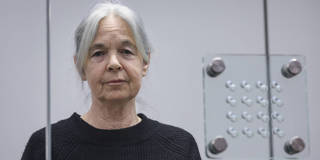
NEW YORK—Last month, a 67-year-old German woman named Daniela Klette was sentenced to 13 years in prison for armed robberies committed between 1999 and 2016. When Klette, one of the last surviving members of the Red Army Faction, was arrested in 2024, authorities found a pistol, an assault rifle, gold, and large sums of cash in her Berlin apartment, where she had been hiding under an assumed name.
The RAF was an anti-capitalist, anti-imperialist, Marxist-Leninist groupuscule that once spooked Germany by assassinating politicians and businessmen, hijacking a plane, and robbing banks, in the hope of staging a global revolution. Most former RAF members are dead. Some of the founders, such as Andreas Baader and Ulrike Meinhof, died in prison in the 1970s, when Klette first became active. The group was officially disbanded in 1998. Two RAF terrorists remain at large.
Klette’s arrest and sentencing, long after her revolutionary cause ended in failure, recalled the case of Onoda Hiroo. An Imperial Japanese Army intelligence officer, Onoda refused to believe that World War II had ended and survived on a small island in the Philippines for decades as a kind of guerrilla fighter, until he was finally brought back to Japan in 1974. Klette and other violent postwar revolutionaries, especially in Germany, Italy, and Japan, suffered from a similar affliction. They, too, were stuck in the last war.
Members of the RAF, the Italian Red Brigades, and the Japanese Red Army (JRA) saw their countries’ complicity in “US imperialism” as an extension of fascism. They did not want to make the same mistake as their parents, who had either collaborated with fascist and militaristic regimes during WWII or kept silent in the face of unspeakable crimes. Instead, they fought violently against what they regarded as the fascist-capitalist world order.
Fusako Shigenobu, born in 1945, was one of the JRA’s most militant leaders, which operated mainly from Lebanon. Her father had been a right-wing extremist in the 1930s and served as a major in the Imperial Japanese Army. After being arrested during a trip to Japan in 2000, she explained that her armed resistance “was closely related to historical circumstances.” Far-left Italian radical activists were similarly convinced that they were carrying on the struggle of the wartime anti-fascist partisans.
It is not surprising that the most militant student movements arose in the former Axis powers. Not only did the postwar generations have to cope with their parents’ complicity or compliance, but many powerful people in Italy, Germany, and Japan had blood on their hands.
Kishi Nobusuke, Japan’s prime minister from 1957 to 1960, was Imperial Japan’s vice minister of munitions during WWII, and before that had overseen vast slave-labor operations in Manchuria. Konrad Adenauer’s first West German government contained several prominent former Nazis. A later West German chancellor, Kurt Georg Kiesinger, had also been a Nazi party member. The conservative wing of Italian politics and industry was riddled with former fascists. All these establishment figures were generally supported and often financed by the United States. Kishi, for example, liked to play golf with President Dwight Eisenhower.
While the rage of the postwar revolutionaries is easy to understand, their radicalism was really a sign of defeat. More moderate student protests against the Vietnam War, authoritarian professors, stuffy sexual mores, and corrupt conservative elites had some success. Social mores became more relaxed. Hierarchies, in education and religion, began to crumble.
But mainstream politics in the US-led “free world” remained relatively conservative, and the capitalist system was never in danger. In the 1970s, student protest dissipated in the ascendant culture of sex, drugs, and rock ‘n’ roll. The revolutionary diehards’ armed struggle was rooted in desperation. Klette is now a dinosaur, one of the last survivors of a war that many people today cannot even remember.
But this has created a new, possibly bigger problem. Postwar politics in Europe, the US, and Japan may have been conservative, but they were not fascistic. Memories of the Holocaust in Europe, and Japanese atrocities in Asia, made militant right-wing ethnic nationalism, let alone racist politics, unacceptable; such ideas survived only on society’s rancid margins.
Young left-wing revolutionaries, so obsessed with memories of WWII, often saw Nazis and fascists even where they didn’t exist, chasing phantoms with actions that were as brutal as they were ineffective. But what if the loss of memory among subsequent generations allows some of those phantoms to come back to life?
No matter how many teenagers read Anne Frank’s diary at school, the violent ideologies of the 20th century—Japan’s war, Mussolini’s fascism, and Hitler’s Third Reich—have gone the way of Napoleon and the Boer War. Vivid memories of past crimes no longer stand as a bulwark against the spread of racist demagoguery and extreme chauvinism.
For a growing number of people, far-right politics are cool. Well-tailored racists promising to deport foreigners and punish “liberal elites” can be very appealing to a younger generation that wants to kick the establishment. The provenance of such radical xenophobia has been forgotten.
As the purveyors of far-right ideas gain political power, their actions become significantly more dangerous than the violent fantasies of a smattering of privileged revolutionaries with homemade bombs. Unlike the Nazis and fascists of yesteryear, they have the ear of the White House.
Ian Buruma is the author of numerous books, including Murder in Amsterdam: The Death of Theo Van Gogh and the Limits of Tolerance, Year Zero: A History of 1945, A Tokyo Romance: A Memoir, The Churchill Complex: The Curse of Being Special, From Winston and FDR to Trump and Brexit, The Collaborators: Three Stories of Deception and Survival in World War II, and, most recently, Spinoza: Freedom’s Messiah (Yale University Press, 2024).
