The EU Needs New Security Partners
Europe’s security order needs to be reconstituted. In a world of fracturing alliances, closer security partnerships with a wider range of states, however small, will increasingly become a source of power, allowing Europe to defend its interests wherever they are at stake.
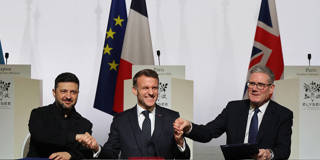
PARIS—For decades, much of Europe viewed military engagement through the lens of NATO or the European Union, since these structures have long shaped how Europeans thought about conflict, deterrence, and security. But the wars in Ukraine and the Middle East have exposed the limits of this approach. With cracks appearing in traditional alliances, new coalitions of the willing, partnerships, and security guarantees for countries outside established strategic frameworks are giving rise to a cat’s-cradle architecture of European security.
Ukraine illustrates this evolution most clearly. Instead of entering a formal alliance with Ukraine, Europeans have spun an intricate web of treaties and commitments offering varying degrees of reassurance and financing. Together, more than 20 bilateral security agreements have codified military support to Ukraine and established a “coalition of the willing” that will contribute to that country’s security after a ceasefire.
Similarly, in the Middle East, European countries have deployed forces in a bid to protect Gulf infrastructure and maintain regional stability. While France has taken the most visible stance, the United Kingdom and the Netherlands have also sent ships, air-defense systems, aircraft, and other capabilities to help defend Qatar, the United Arab Emirates, and Saudi Arabia. Meanwhile, a wide range of countries—including the UK, France, Germany, Italy, the Netherlands, Denmark, Latvia, Slovenia, Estonia, Norway, Sweden, Finland, the Czech Republic, Romania, Lithuania, and several partners outside the EU—have committed to helping ensure freedom of navigation and regional security after the war.
These European responses point to several new tendencies. The ad hoc coalitions that are emerging increasingly stretch across established alliance lines. Not only are NATO and EU countries acting together through groupings like the Joint Expeditionary Force, the Nordic-Baltic Eight, the Weimar Triangle, the Bucharest Nine, and various other intra-alliance frameworks. They also are expanding their security commitments vis-à-vis non-member states such as Ukraine, Qatar, the UAE, and Saudi Arabia.
The logic behind these choices is clear. Ukraine’s security has become central to Europe’s own. If Russia wins its war, resumes its attack after a ceasefire, or sets its sights on other regional targets, the threat to Europe would be immediate and severe. A Russian-controlled Ukraine—with all its natural resources, human capital, and industrial capacity (particularly its new cutting-edge defense industries)—would represent an existential strategic challenge not only for Poland and Germany, but also for France, Norway, Spain, and the rest of Europe.
The same logic explains Europe’s recent contributions to Middle East security. The Gulf monarchies’ stability bears directly on Europe’s energy security, economic outlook, and political dynamics. Europeans need to engage wherever their interests are directly at stake, including beyond the traditional alliance perimeter. Europe’s accession states (those pursuing EU membership) remain “grey spots” on the map—strategically important, but, in this new world of flexible coalitions and shifting alliances, insufficiently protected.
The most critical is Moldova. After providing Ukraine and the Gulf monarchies with various security guarantees, it is only reasonable that Europe would design a similar architecture to ensure Moldova’s peace and security, given the country’s implications for European security.
Developments in recent months have shown why European security guarantees are necessary. In March, a Russian strike on a Ukrainian hydropower dam caused a massive oil spill in the Nistru River, contaminating Moldova’s main water supply. Moldova’s second-biggest city and multiple districts were left without clean water for weeks (until Romania and other EU members rushed to help). Then, a Russian drone strike on Ukrainian territory damaged part of Moldova’s electricity interconnector with Romania, underscoring a continuing risk from the war. Clearly, Russia has determined that it will face no costs for such behavior.
Despite these pressures, Moldova has stood firm. In March, it formally launched the process of joining the coalition of the willing supporting Ukraine—a remarkable step for a constitutionally neutral country. This new stance reflects a hard-won understanding: even neutral states’ security depends on solidarity and mutual defense.
Another key region is the Western Balkans. With defense spending rising and geopolitical fault lines deepening, the risk of destabilization cannot be ruled out. Establishing coalitions of the willing to provide reassurance or collective security commitments to all accession states could help maintain stability and calm anxieties. Europe should formally guarantee the existing borders in the region, which would bolster its own credibility as a guarantor of peace, both within its borders and along its frontier.
Europe’s security order needs to be reconstituted. In a world of fracturing alliances, closer security partnerships with a wider range of states, however small, will increasingly become a source of power, allowing Europe to defend its interests wherever they are at stake. Deepening defense links with EU accession states and offering security guarantees should be a top priority.